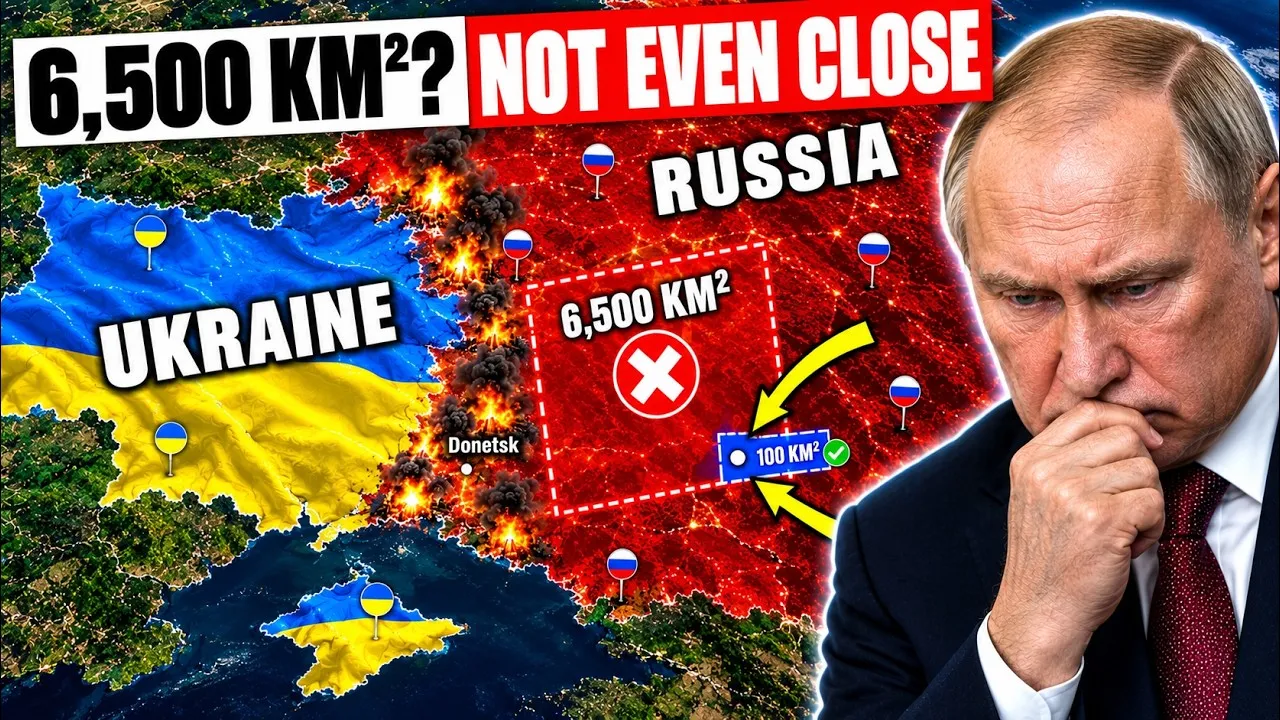
Putin claims 6,500 km² taken in 2026. Independent analysts count about 100
On 16 October Vladimir Putin said Russian forces had taken about 6,500 square kilometres of Ukraine this year. The Institute for the Study of War counts about 100 for the same period – here is how two counts of one front can differ so much.

 Illustration
Key points
- Putin said Russia had taken about 6,500 km² and 310 settlements since January. That he said it is confirmed; the figure itself is a claim. CLAIMED – Claimed: stated by a government, army or official, but not independently verified.
- The Institute for the Study of War (ISW) counts about 100 km² and 69 settlements over the same period.
- By ISW's count, Russia has had a net loss of about 122 km² since 1 September.
- Most of the gap comes from what counts as “captured”: a few soldiers in a village are not the same as control.
- Independent counts have limits too, and Ukraine's own claims face the same test.
Watch the video
On 16 October, Vladimir Putin told Russia’s top generals that Russian forces had taken about 6,500 square kilometres of Ukraine since the start of the year, along with 310 settlements. Source [1] The Institute for the Study of War (ISW), a US research group that tracks the front line every day, counts about 100 square kilometres and 69 settlements for the same ten months. Source [2]
One number is roughly 60 times the other. A gap that big needs more than a headline. This article sets out exactly what was said and by whom, how analysts measure territory and where that method has limits, and which claims are confirmed, only claimed, or not verifiable yet.
The background
By mid-October the heaviest fighting is in four regions: Donetsk, Zaporizhzhia, Kharkiv and Sumy. Both sides publish claims every day. Russia’s Defence Ministry announces captured villages; Ukraine’s General Staff reports attacks repelled. Neither side’s numbers can be taken at face value, so independent analysts check them.
ISW’s daily assessments draw on official statements from both sides, Russian military bloggers, satellite imagery, geolocated video and independent open-source analysts. Source [2] The method has limits, set out below. But it is public, and that is what allows a comparison with the Kremlin’s number.
What is confirmed
The Kremlin’s own website carries the statement, dated 16 October, from a meeting with the General Staff leadership and senior commanders at a forward command post. There, Putin says that about 6,500 square kilometres and 310 settlements have been “liberated” since the start of the year. Source [1] CONFIRMED – Confirmed: backed by at least two independent, reliable sources or by direct evidence.
Note what is confirmed here: that he said it, not that it is true. The figure itself is a claim. CLAIMED – Claimed: stated by a government, army or official, but not independently verified.
ISW’s assessment of the same day also reports that Valery Gerasimov, Russia’s chief of the General Staff, claimed more than 1,800 square kilometres and 92 settlements since 1 September alone. Source [2] CLAIMED – Claimed: stated by a government, army or official, but not independently verified. By our arithmetic, that would mean more than a quarter of Putin’s ten-month total came in about six weeks.
The independent count
ISW’s 16 October assessment says Russia has seized about 100 square kilometres and 69 settlements since 1 January. Source [2] It also says something more striking: since 1 September, Russia has had a net loss of about 122 square kilometres. Net means gains minus losses. In other words, the ground Russia lost to Ukrainian counter-attacks since September outweighs the ground it gained.
One caution on the numbers. A day later, United24 Media published a calculation based on a slightly different ISW figure – 144.5 square kilometres for January to September. Source [3] On that basis, Putin’s number is about 45 times too large. The two figures cover different periods, and we could not confirm how ISW moves from one to the other. Using either, the Kremlin’s claim is between about 45 and 65 times larger than the independent estimate.
The same pattern shows up region by region:
- Donetsk region. Putin said Ukraine holds just over 10% of it. ISW puts Ukrainian-held territory there at 5,530 square kilometres, or 20.4%. Source [2]
- Zaporizhzhia region. Putin said Ukraine holds 16.5%. ISW says 24.6%. Source [2]
- Zaporizhzhia city. Gerasimov claimed Russian troops are within 5 kilometres of the city’s southern outskirts. CLAIMED – Claimed: stated by a government, army or official, but not independently verified. ISW places the nearest Russian forces at least 21 kilometres away, or about 12 if limited infiltration is counted. Source [2]
Why two counts of the same front differ so much
Three things explain most of the gap, each shown in ISW’s 16 October assessment. Source [2]
1. A village “captured” is not a village controlled. Gerasimov claimed Russian forces seized Kostiantynivka in July, and a Russian military blogger now claims full control. CLAIMED – Claimed: stated by a government, army or official, but not independently verified. ISW says it has seen Ukrainian forces in western Kostiantynivka as recently as 10 October, with Russian infiltration only in the southern and central parts and none in the north.
Kupiansk is similar. Gerasimov claimed two villages, Palamarivka and Kovalivka. ISW sees only limited infiltration in Tyshchenkivka and puts the nearest assessed Russian advances more than 5 kilometres east, near Rodkivka. In Dobropillia, Gerasimov claimed the town and named the units involved; ISW sees limited infiltration, and Ukrainian forces denied that Russia had consolidated control.
So the first source of the gap is a definition. A few soldiers in a village can be reported as a captured village. An analyst asks whether anyone actually controls it.
2. Distance. Gerasimov says Russian troops are about 5 kilometres from Zaporizhzhia city; ISW says at least 21. For Druzhkivka and Kramatorsk, two cities in Donetsk region, ISW places Russian forces at least 12 and 9 kilometres away respectively, even counting infiltration.
3. Areas, not just places. In Kharkiv region, Gerasimov claims Russia’s Northern Group of Forces completed an encirclement, taking 461 square kilometres and 28 settlements. CLAIMED – Claimed: stated by a government, army or official, but not independently verified. ISW says it found no evidence of an encirclement. The group’s commander, Nikiforov, says Russia controls 465 square kilometres, about three-quarters of a border “security strip”; ISW’s count for that strip is 205.77 square kilometres. In Sumy region, Nikiforov claims more than 300 square kilometres over the summer and autumn, while ISW counts 99.1 square kilometres since 1 January.
Be careful with that last pair: the periods differ, so they are not directly comparable. That is why we show them as “claimed” and “assessed”, not as proof of a lie. Every Russian claim quoted here counts gains only.
The limits of the independent count
These limits matter. ISW’s figures are estimates. They depend on footage and imagery that exist, and on judgement calls about what counts as control. Some areas are simply hard to see. And ISW is a Western think tank that says clearly where it thinks Russia is failing. That is a perspective, which is why we show the method and not only the number.
Ukraine is not fully transparent either. ISW notes that Ukraine stopped publicly reporting Russian missile launch and interception numbers on 11 August. Source [2] Ukrainian claims go through the same test as Russian ones.
Each side’s claims
Russia – Putin, Gerasimov, Nikiforov and the Defence Ministry – claims a large and accelerating advance. ISW reports that Putin described Russian forces as advancing confidently along the entire front. Putin also said the goal of “absolute security” for the border areas is not something Russia plans to put on the table in peace talks. Source [1] CLAIMED – Claimed: stated by a government, army or official, but not independently verified.
Ukraine. The General Staff reported 60 Russian attacks in the Dobropillia and Pokrovsk directions in the 24 hours to 8am on 16 October. Source [4] CLAIMED – Claimed: stated by a government, army or official, but not independently verified. Ukraine’s 17th Army Corps said on 15 October that Ukraine controls Novoandriivka, a village Gerasimov claimed Russia had taken. Source [5] CLAIMED – Claimed: stated by a government, army or official, but not independently verified. ISW says Ukrainian forces recently advanced in western Zaporizhzhia region near Stepnohirsk. Source [2]
ISW’s overall conclusions
These are assessments, not facts. ISW assesses that Russia’s war effort is failing to achieve its operational and strategic objectives, that Russian recruitment numbers have decreased, and that Russia is unlikely to capture Ukraine’s “fortress belt” militarily. It points to Ukrainian counter-attacks, including an operation north of Lyman. Source [2]
ISW also offers a reason for the inflated claims: it argues they are part of a broader information campaign meant to make Russian advances look inevitable and to push Ukraine and its Western partners towards Moscow’s negotiating demands. Source [2]
One more independent signal: United24 Media reports that Black Bird Group, a Finland-based group, found Russia’s net territorial gains fell in the latest month to their lowest level since June 2023, which it attributes to Ukrainian counter-attacks in northern Donbas and expanded drone operations. Source [3] We have not seen Black Bird’s own report, so treat this as reported, not verified. UNVERIFIED – Unverified: reported, but we could not check it. Treat with caution.
Why the number matters
Scale. Ukraine covers roughly 600,000 square kilometres. By our arithmetic, 6,500 would be about 1% of the country; ISW’s count of about 100 would be less than two hundredths of one per cent.
Negotiations. ISW assesses that the Kremlin remains committed to its war aims through military means, and Putin said Russia does not plan to make its border-security goal a subject of peace talks. Put together, a large battlefield number is useful to Moscow.
A pattern on the same day. ISW reports that Putin signed a decree placing the Russian assets of five European companies under temporary management, including Tarkett of France and Ontex of Belgium, and linked the seizures to pressure on European states, including over frozen Russian assets. Kremlin spokesman Dmitry Peskov called the decisions reversible. Source [2]
Our view – and it is a view, not a fact – is that when one side’s claims are far larger than independent counts, decisions about aid and diplomacy risk being made on the larger number. That is why we show our work.
What this does not mean
The independent numbers say the Russian advance in 2026 is far smaller than Moscow claims, and that since September it has gone backwards by ISW’s count. They do not say the war is won. The same sources point to real risks:
- Air attacks. ISW reports about 464 Russian drones launched on 16 October alone – 149 overnight and 315 during the day – plus loitering munitions. Most were shot down, but strikes caused large power cuts: Volyn region reported 270,000 customers without power and Kharkiv city 280,000. Source [2]
- Rebuilding equipment. Citing satellite imagery and reporting by RFE/RL’s Mark Krutov, ISW says Russia is partially restocking armoured vehicles and self-propelled howitzers at several storage bases. ISW assesses this as modest, with many vehicles repaired or refurbished, and not an imminent threat to NATO. Source [6]
- Politics. A weak battlefield result does not, by itself, change the Kremlin’s intention to win by force.
- Measurement. The two ISW-based figures shown here, 144.5 and about 100 square kilometres, do not match, and we could not reconcile them. No single number here should be treated as final.
- Ukraine’s claims carry the same uncertainty until they are verified.
What to watch next
- Kostiantynivka – whether new footage shows Russian control or a Ukrainian presence in the city. It is the clearest test of claim and counter-claim.
- ISW’s net figure – does the net loss of about 122 square kilometres since 1 September hold, grow or reverse?
- The distance to Zaporizhzhia city – 5 kilometres according to Gerasimov, at least 21 according to ISW. Verifiable footage will settle it.
Sources
- Kremlin (official website), “Putin's remarks at a meeting with the General Staff leadership and senior commanders”, .
- Institute for the Study of War (ISW), “Russian Offensive Campaign Assessment”, .
- United24 Media, “Calculation of Putin's claim against ISW figures; report on Black Bird Group's findings”, .
- General Staff of the Armed Forces of Ukraine, “Daily operational update”, .
- Ukraine's 17th Army Corps, “Statement on Novoandriivka”, .
- RFE/RL (Mark Krutov), cited by ISW, “Satellite imagery of Russian equipment storage bases”.